Articles by "Apps"

You've circled the block six times. Fifteen minutes have passed. Would you pay to secure someone else's parking spot? A startup called MonkeyParking thinks San Francisco residents will — and it's created an app to prove it.
Parking
MonkeyParking is simple to operate: It connects to your Facebook account to create a profile; you then enter the location of where you're parked, or where you want to park. If you’re looking for parking and see a user — known as a "Monkey" — leaving his or her spot, you can start bidding for it, starting at $5. MonkeyParking said the average bid ranges from $5 to $10. Currently, the app is only available in two cities: It launched in San Francisco last month, and in Rome, Italy, on May 11.
See also: Activists Take San Francisco to Court Over 'Google Buses'
However, MonkeyParking has caused a backlash among San Francisco residents who believe it will inflate parking costs by encouraging parking squatters (those who will save their parking spots only for MonkeyParking users) and users who will only accept the highest bid. This has caused controversy in a city already fragmented by debate over rapid gentrification and tech-company shuttle buses. But these accusations have come as a shock to the man behind the parking app.
"They are talking about MonkeyParking like it’s been here forever and we just launched a month ago," Paolo Dobrowolny, CEO and co-founder of MonkeyParking told to Mashable. “These [issues] are not happening now, and it’s never going to happen because it’s something we can control.”
Some residents believe parking squatters will only leave their spot if a bid comes in, rather than give the spot to a non-MonkeyParking user for free. Others believe users will only accept outrageously high bids for a parking spot, leaving those who don't have spare cash hanging.
Pictured here are two screenshots from the app, Monkey Parking.
Dobrowolny said the app already has preventative measures in place to stop the latter from happening. When you place a bid, the driver in the parking spot only sees that someone has placed a bid — no price is given. The company also told Mashable that it can track anyone abusing the service, and remove them from the app.
Two screenshots from the app, MonkeyParking.
“We don’t want to create an infinite price for a parking spot, “ Dobrowolny said. “If it’s an unfair app, it wouldn’t help anyone — including us. We just want the app to be a tool that helps people, and nothing more than that.”
As for the app’s legality, the San Francisco City Attorney's office told SFGate that it is currently determining whether an app like MonkeyParking is legal. Dobrowolny told Mashable that he views the app as trading information about parking, rather than the spots themselves.
And parking spots really matter to San Francisco residents. A recent San Francisco Municipal Transportation Agency parking census reported that the city has 440,000 parking spots available, but only 275,000 of those are street parking, according to Oakland, Calif.-based television station KTVU.
This is why some see MonkeyParking as an app that will only add to San Francisco's parking problem, since the money spent bidding on spots goes back into a user’s pocket, rather than to the SF MTA. Uptown Almanac, a local San Francisco culture blog, said money made from street parking helps pay for important infrastructural needs. This includes funding the San Francisco Police Department for security purposes, such as monitoring fare evasion on MUNI, a local public-transportation system.
However, Dobrowolny is willing to use its app to help the cities in which it is available, and believes they share a common goal of improving urban life. He said he views the money spent on bidding as an equal exchange: A user leaves a spot and earns $5, but will then likely spend that $5 again on a parking meter.
All this fuss may not even matter, however, as some drivers in San Francisco are not convinced they’ll use the app that often.
“I don’t really see it becoming part of somebody’s everyday routine,” Cory Abbe, a San Francisco resident and driver told Mashable. “I see it something like Uber, where only if someone is in a rush to get somewhere would actually use the app.”
Dobrowolny believes MonkeyParking will only help expedite the parking process, and won't become an alternate source of income for users. “This is not like Uber or Lyft, where it can help pay for bills," he said. "At most, it can just repay your parking-meter expenses.”
Currently, MonkeyParking is only available on iOS. The company plans to continue to expanding to other cities and operating systems.
“We believe this app can work if there is a community that uses it fairly both ways,” Dobrowolny said. “We can prove it — just give us time.”

Oman beats Nepal by two wickets on third day of the Asian Cricket Council Premier League
Malaysia upsets Afghanistan for first win - Cricket News
Malaysia bowlers kept chipping away with wickets as Afghanistan folded for 175.
Khizar Hayat’s four-wicket haul helped Malaysia secure an upset win against Afghanistan in the seventh match of the Asian Cricket Council Premier League at the Bayuemas Oval in Kuala Lumpur on Sunday (May 4).
Afghanistan was kept to a modest total of 175 in 46 overs, and Malaysia achieved the target in 37 overs, winning by three wickets and overcoming a few hiccups in its chase.
Anwar Arudin (34) and Ahmed Faiz (44) gave Malaysia much-needed momentum in the chase with a 40-run stand for the second wicket in 4.5 overs after Hammadullah Khan had fallen for just 6 in the fourth over. In at No.4, Shafiq Sharif ensured the runs kept coming with a 77-ball 44. 
When Malaysia was just ten runs away from victory, it lost Sharif, Suhan Alagaratnam (15) and Hayat (5) in quick succession but with not enough runs on the board, Afghanistan couldn’t force a win.
Earlier, Hayat had taken 4 for 29 with his offspin after Malaysia chose to bowl first. He accounted for the first three batsmen after openers Noor Ali Zadran (18) and Usman Ghani (36) had made a steady start. Wickets fell regularly, and apart from Ghani, Nasir Jamal, who also made 36, was the only batsman to go on and make good score after getting a start.
That trend was reflected in the partnerships, with Afghanistan having a string of decent ones, but not converting any of them into a big stand.
Hayat’s efforts netted him the Man of the Match award.
In another match on Sunday, Oman won a close game by two wickets over Nepal at the Selangor Turf Club. Aamir Kaleem starred with the ball for Oman and was awarded the Man of the Match.
Kaleem’s 4 for 36 was instrumental in restricting Nepal to a manageable total of 157 all out in 47 over. Oman then chased down the target in 47.5 overs but not before the Nepal bowlers put up a valiant effort.
Put in to bat, Nepal got off to a bad start with Subash Khakurel scoring a second consecutive duck, but Gyanendra Malla (26) and Naresh Budayair (23) steadied the innings with a 40-run stand. The Oman bowlers fought back and kept chipping away with wickets as Nepal could put up only a modest total.
Zeeshan Maqsood and Ajay Vrajlal Lalcheta picked up two wickets each for Oman.
The start of Oman’s innings was also not ideal, as it lost Zeeshan Siddiqui for a duck. Maqsood (44) and Vaibhav Wategaonkar added 50 runs for the second wicket to get the chase going. Though Wategaonkar fell for 8 in the eighth over, Arif Hussain (23) and Maqsood didn’t let the momentum swing towards Nepal as the duo added another 37 runs in 8.5 overs.  
However, Shakti Gauchan (2 for 19) and Paras Khadka (2 for 23) kept things tight and were rewarded for their economical bowling. With eight wickets down for 126, a calm-headed performance by captain Sultan Ahmed (32 off 55 balls) ensured Oman claimed its second victory of the tournament.
Oman will play Afghanistan in its next match, while, Nepal will be up against Hong Kong on May 5. Malaysia will play the United Arab Emirates on the same day.

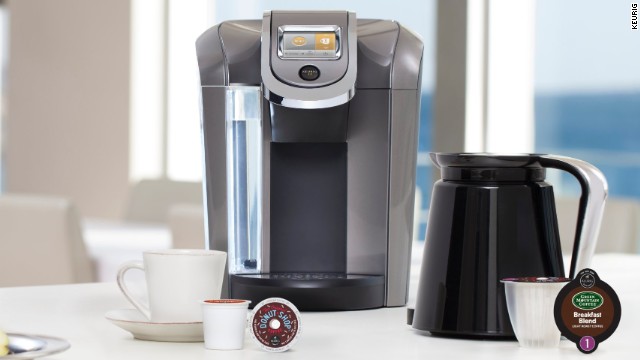
Behold! The new Keurig 2.0 machine.
I use a Keurig coffee machine at home because I'm lazy. And, quite frankly, don't feel like I've really done my duty to God and country until I've added a little something to the landfill.
"Here ya go, America. Have another K-Cup. Go Braves."
Though, to be fair, I do actually use 97% biodegradable French roast OneCups from San Francisco Bay, a brand of the Rogers Family Company out of Lincoln, California.
Mind you, I use these OneCups not so much for environmental reasons, but because the price is right and I quite like the taste.
"Apparently This Matters" Is Jarrett Bellini's weekly (and somewhat random) look at social-media trends.
So hold your praise. I'm still a delightfully lousy, wasteful human being.
However, my day-to-day brand of single-serve coffee may soon be a thing of the past, because this fall Keurig plans to launch a new system that will use DRM (Digital Rights Management) technology. It's fancy science, but ultimately it means unlicensed cups won't work with the new machines.
Kate Binette, senior public relations specialist from Green Mountain Coffee Roasters, the parent company of Keurig, couldn't tell me exactly how their new interactive technology would work -- and even if she did I'd probably have to take a 40-minute nap -- but I did get the basics.
"Each Keurig 2.0 brewer will have a camera that can 'read' a proprietary taggant material," Binette says, adding that it's similar to current anti-counterfeiting technology and will be "embedded on the lid of each Keurig brand pack."
So, essentially, our coffee is going bionic, and if your current pod doesn't have that taggant, it's no coffee for you!
This includes my OneCups from San Francisco Bay.
Which can only mean ...
Brace yourself. Litigation is coming.
Welcome to the Great Electronic Coffee War of 2014!
Tiago Barros: \Green Mountain argues that its new advancements in roasting and flavor extraction, as well as thermodynamics, have been expertly developed to ensure perfect consistency with each cup.
Therefore, Binette told me, "It is critical for performance and safety reasons that the system only brews Keurig brand packs."
Tiago Barros: "The sanctity of the K-Cup should be respected!"
And I didn't have to look far to find someone who agrees with that assessment.
My co-worker, Tiago, says he doesn't want somebody's inferior brand of K-Cup malfunctioning and screwing up his system, declaring from his desk three cubicles away, "The sanctity of the K-Cup should be respected!"
Mind you, I once said the exact same thing about Lean Pockets.
It was 2:30 a.m. I was outside. Not wearing pants. In the rain.
"The sanctity of the Lean Pocket should be respected!"
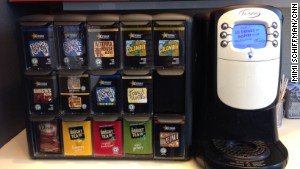
Other options: CNN has these fancy Flavia machines in New York. Here in Atlanta we drink from giant coffee urns that may or may not ever get cleaned. Looking back, that probably wasn't my finest moment.
Anyway, while Keurig says adding DRM is all about performance, Jon Rogers, founder and president of the Rogers Family Company (makers of my San Francisco Bay coffee) calls it "baloney."
He thinks it's all about money and keeping non-Green Mountain coffee out of your hands.
Other options: CNN has these fancy Flavia machines in New York. Here in Atlanta we drink from giant coffee urns that may or may not ever get cleaned.
By e-mail, he explained to me, "Prices would be higher to the consumer. Innovation would be stifled."
In February, another company, TreeHouse Foods Inc., even filed a lawsuit against Green Mountain. The Rogers Family Company is considering legal action as well.
Jon Rogers says, "If Green Mountain Coffee Roasters is allowed to introduce Keurig 2.0 with the feature that, in our opinion, is clearly in restraint of trade, the Keurig 2.0 monopoly would be reinstated as it was when Keurig 1.0 was the only brewer on the market."
Whatever happens, it'll be interesting to see this play out over the coming months.
But I do have to say that the new Keurigs are really sexy. Plus, in addition to brewing single cups, they'll also do full carafes.
So, never mind whose cup you choose (or are allowed) to brew.
Brace yourself. Multiple sprints to the bathroom are coming.

I'm not a violent man. Short, self-doubting gingers tend not to be the fiercest of creatures.
But if you are sitting next to me on a plane I will absolutely fight you for the armrest.
\Mind you, when I say "fight," I mean "create a mental checklist of things I would do to you in the event that I suddenly ceased to be a short, self-doubting ginger."
So, you're safe.
"Apparently This Matters" Is Jarrett Bellini's weekly (and somewhat random) look at social-media trends.
Sadly, when it comes to hand-to-hand combat, my signature move is silent resignation. Thus, when it comes to armrests, I resort to strategy and the early boarding benefits bestowed upon me by virtue of having an airline credit card.
Don't scoff at early boarding. I'd sooner give up my pants than Zone 1.
Truthfully, though, you can just have my pants.
Of course, there are a number of other great reasons for boarding early -- the big one being that I'm able to quickly secure my bag in an overhead compartment before they all fill up with the four-wheeled shipping containers some of you now feel qualify as a small personal item.
But it's definitely also about getting seated and into the ready position.
Which is to say: Body wide. Muscles clenched. Armrests secured.
"Claimed!"
Nothing greedy. Just simply taking what's rightfully mine in accordance with the rules.
And there are rules.
In Season One (episode four) of the brilliant TV series "Legit," comedian Jim Jefferies perfectly details these rules from his middle seat as he battles another passenger for the right to be mildly more comfortable.
"You don't know plane etiquette," Jefferies shouts to the man sitting to his left. "Window gets an armrest and a wall. Middle gets two armrests. Aisle gets an armrest and a little bit of extra leg. We're not animals! We live in a society!"
So, those are the rules. Not that any of you are going to follow them.
Fortunately, however, there's a new armrest design that may settle the matter once and for all.
Behold! Doube-deck geometry. Interesting, but methinks they\'re still going to murder each other.It's called the Paperclip Armrest, and throughout the week it seemed to be popping up all over the Web and social media. Apparently armrest inequality is quite the hot-button issue, so it struck a nerve with anyone who's ever had a boarding pass that included the letter B or E.
The Hong Kong-based team at Paperclip Design claim their innovation solves the "perennial problem of fighting for elbow room in high-density seating" by using "double-deck geometry."
The basic idea is this:
Paperclip's armrest extends out as normal but then, at the end, it curls up several inches and fishhooks back for several more, making use of the "vertical space" to create a second deck.
Behold! Doube-deck geometry. Interesting, but methinks they're still going to murder each other.
So, one person gets the lower. And one person takes the upper.
Sadly, this does not qualify you for the Mile High Club.
All that said, I still think the design has a critical flaw.
You see, while the person using the upper deck is mostly getting support for his or her forearm, the person using the lower deck gets to position the entirety of his or her elbow directly on the rest.
And that's important. Comfort starts in the elbow.
Later, in the same scene from that episode of "Legit," the man arguing with Jim Jefferies eventually says, "I am only taking the back of the armrest. You can have all the rest."
Jefferies drives home the importance of the elbow by replying, "You take the back, you take the whole damn thing."
So, the Paperclip Armrest might not be a perfect design -- I'm certainly not convinced -- but it does seem to be a start.
However, until we finally sort it out, we're just going to have to obey the rules and force them upon those who act like animals.
Which is to say: Body wide. Muscles clenched. Armrests secured.

Foursquare to split into two appsFoursquare, Dennis Crowley's location-based mobile app, is breaking apart its core business into two separate mobile products: a social check-in app Swarm, and a venue-discovery app, Foursquare.

Swarm is taking on all of Foursquare's current social features, such as check-ins and friends' whereabouts. It will be launching in the upcoming weeks. Crowley describes it as a "social heatmap" to The Verge that shows where you and your friends are without always having to actively check-in. The new app uses a number of signals from your phone, from GPS to the numbers of bars, to more accurately guess where a user is, and it can reveal which neighborhood you're currently in to friends. It sounds like Swarm might also have a messaging or "broadcast" component, to let you meet up with friends nearby more easily.

The remaining Foursquare app will focus on the "Explore" feature and make Crowley's company much closer to a full-on Yelp competitor. "Explore," is a way to search for things to do and places to visit based on check-in data. It doesn't sound like the app will keep its check-in button.

Foursquare began rebuilding its app and working on Swarm in late 2013. It noticed that users were either using Foursquare to find cool new places or to check-in, but most people weren't doing both at the same time.

"Our company has always been about helping you keep up and meet up with their friends, and discover great places," the company writes in a blog post. "Our two new, unbundled apps are designed to do that for everyone. Swarm is for people who want the fastest and easiest way to connect with their friends. Foursquare is for explorers who want to know about the best spots, and to share what they've found with others."

Foursquare has raised more than $120 million. It has tens of millions of users who have produced more than 5 billion check-ins.

MKRdezign

Contact Form

Name

Email *

Message *

@AR Akash. Powered by Blogger.
Javascript DisablePlease Enable Javascript To See All Widget